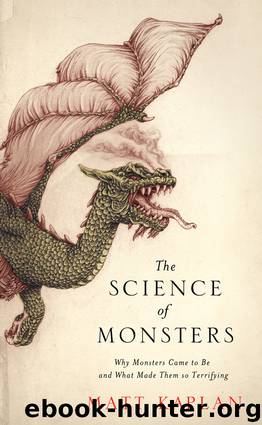
The Science of Monsters by Matt Kaplan
Author:Matt Kaplan
Language: eng
Format: epub
ISBN: 9781472101167
Publisher: Little, Brown Book Group
The Nightmare, by Johann Heinrich Füssli. Oil on canvas, 1781. Detroit Institute of Fine Arts/Marc Charmet.
This is very different from the way things once were. The origin of the word “demon” is the ancient Greek word daïmôn, which comes from the verb daïein, meaning “to distribute.” It was sometimes used during the days of Homer as a synonym for “god” but, more often than not, was associated with entities that distributed people’s destinies. Unlike the gods on Mount Olympus, daïmônes were not actively worshipped. They were just poorly defined supernatural beings that were neither really good nor really bad. Hesiod describes them as the watchers of Zeus who spy on mortals and as assistants to the gods. He also suggests that some people became daïmônes when they died. Plato theorizes that they were intermediaries between gods and men that were not gods themselves. They were sometimes associated with bringing dreams to people but were not specifically responsible for nightmares.
The appearance of Satan in mythology changed the role of daïmônes such that they started being viewed in a more negative way. Satan, or Ha-Satan, as he is known in the Hebrew Bible, is initially tasked by God to put the righteous believer Job through hardship to test whether he will prove faithful only during times of health and prosperity or at all times. Ha-Satan makes Job suffer terribly, but all of this suffering is brought about by Ha-Satan’s powers alone; there are no servants working for him. However, with the rise of Christianity, Ha-Satan ceased to be an angel who tested the faith of humanity under the instruction of God and transformed into Satan, an enemy of God who commanded legions of twisted minions.
The once neutral daïmônes of the world came to be known as demons and started to function as an army of darkness that Satan could command to corrupt mortals in his war. People who were thought to be working with Satan came to be known as witches and wizards, and it was widely believed demons were sent to aid these villainous individuals in their work. These assistant demons, or imps, as they were called, often took mundane animal forms. They could appear as toads, rats, owls, goats, and cats so they could help witches and wizards without being too easily noticed by neighbors.*
By the late Middle Ages, demonology and the myths surrounding it were extremely rich and fears were surging. Like animals, demons of different sorts were treated as species that specialized in tormenting people in various ways, and those that came to be among the best known were the demons fueling feelings of lust: the succubus and the incubus.
The succubus was a she-demon intent on bending men to her will and siphoning away their souls through sex. The incubus was her male counterpart, a monster capable of corrupting young women, like Landolt in The Nightmare, and led these ladies to lives of debauchery. Both names derive from the sexual positions that these demons were thought to take. Succubus stems from the Latin word succubare, meaning “to lie under.
Download
This site does not store any files on its server. We only index and link to content provided by other sites. Please contact the content providers to delete copyright contents if any and email us, we'll remove relevant links or contents immediately.
Cecilia; Or, Memoirs of an Heiress — Volume 1 by Fanny Burney(32558)
The Great Music City by Andrea Baker(32018)
Cecilia; Or, Memoirs of an Heiress — Volume 2 by Fanny Burney(31956)
Cecilia; Or, Memoirs of an Heiress — Volume 3 by Fanny Burney(31941)
We're Going to Need More Wine by Gabrielle Union(19046)
All the Missing Girls by Megan Miranda(16026)
Pimp by Iceberg Slim(14506)
For the Love of Europe by Rick Steves(14121)
Bombshells: Glamour Girls of a Lifetime by Sullivan Steve(14075)
Talking to Strangers by Malcolm Gladwell(13370)
Norse Mythology by Gaiman Neil(13363)
Fifty Shades Freed by E L James(13240)
Mindhunter: Inside the FBI's Elite Serial Crime Unit by John E. Douglas & Mark Olshaker(9342)
Crazy Rich Asians by Kevin Kwan(9292)
The Lost Art of Listening by Michael P. Nichols(7506)
Enlightenment Now: The Case for Reason, Science, Humanism, and Progress by Steven Pinker(7313)
The Four Agreements by Don Miguel Ruiz(6765)
Bad Blood by John Carreyrou(6621)
Weapons of Math Destruction by Cathy O'Neil(6279)
